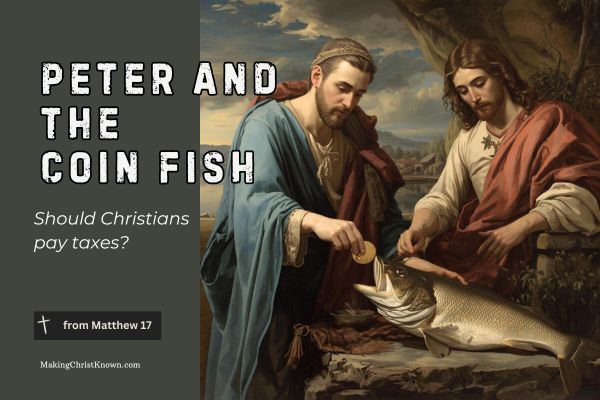
What if paying a tax became a lesson in faith? One question asked in Capernaum led Jesus to perform one of His most unusual miracles—a coin from a fish. This short but powerful story teaches us about obedience, humility, and where our true loyalty belongs.
In this Bible study lesson from Matthew, we look at the story often called Peter and the Coin Fish and what it means for believers today. Question: Should Christians pay taxes?
Peter and the Coin Fish: A Matter of Paying Tax in Capernaum
When Jesus and His disciples arrived in Capernaum, a simple question sparked a meaningful conversation.
“When they came to Capernaum, those who collected the two-drachma tax came to Peter and said, ‘Does your teacher not pay the two-drachma tax?’” (Matthew 17:24)
Every Jewish man was required to pay this temple tax. At first glance, the question seemed routine. Yet Jesus was no ordinary teacher. He was the Son of God and the true King.
Jesus Explains the Bigger Picture
“What do you think, Simon? From whom do the kings of the earth collect customs or poll-tax, from their sons or from strangers?” (Matthew 17:25)
Peter answered correctly—kings collect taxes from strangers, not their own children.
“Then the sons are exempt,” Jesus said. (Matthew 17:26)
Jesus made a powerful point. As the Son of God, He did not owe the temple tax. Still, He chose to pay it.
Why Did Jesus Pay Taxes with the Fish Coin?
Jesus wasn’t obligated, but He acted out of wisdom and humility.
“However, so that we do not offend them, go to the sea and throw in a hook… you will find a shekel. Take that and give it to them for you and Me.” (Matthew 17:27)
This miracle—the famous coin from a fish—shows us that Jesus values peace, obedience, and testimony. He avoided unnecessary conflict while still teaching eternal truth.
The Temple Tax and Jesus’ Authority
The temple tax supported worship and maintenance of God’s house. Although Jesus had divine authority, He chose submission to avoid becoming a stumbling block.
This moment echoes other miracles, such as when Jesus provided food for thousands. You can read more about that here:
Jesus Feeds Five Thousand People.
Our Active Role in God’s Plan
Notice something important. Jesus provided the money—but Peter still had to act. Peter went fishing. God supplied the miracle, but Peter participated in receiving it.
Salvation works the same way. God offers grace freely through our belief in Jesus Christ, but He calls us to respond in faith and obedience.
A Simple Story About Faith and Action
There’s an old story that illustrates this truth well.
A man was trapped on his roof during a flood. A rescue boat came, but he said, “God will save me.”
Another boat arrived. Again, he refused. Then a helicopter came, offering a rope. He declined.
When the man drowned and asked God why He hadn’t saved him, God replied, “I sent you two boats and a helicopter.”
God provides—but He also expects us to act.
God Saves by Grace—But Calls Us to Respond
Everything we have comes from God. Still, He invites us to participate in His work. This applies to giving as well. You can better understand this idea in the lesson on
Christian tithing.
Should Christians Pay Taxes?
So, should believers pay taxes?
Short answer, yes. Scripture teaches us to obey the laws of the land and respect governing authorities. At the same time, our highest loyalty must always belong to Christ.
Governments may provide services, but only Jesus offers eternal life. That’s the heart of the lesson.
Love in Christ,
Bob
If you would like to discover more about Jesus and His message, visit the Making Christ Known homepage for more Bible lessons.
You can also begin with this well-known verse: Read John 3:16.
*Verses from the New American Standard Bible (NASB).
Discover more from Making Christ Known
Subscribe to get the latest posts sent to your email.