God Turns Aaron’s Staff into a Snake – Lesson from Exodus 7
What happens when someone witnesses a miracle but still refuses to believe? In Exodus 7, God gives Pharaoh a powerful sign through Aaron’s snake staff. Yet, even after seeing this amazing display of God’s power, Pharaoh refuses to listen. This unusual encounter teaches us an important lesson about faith, spiritual deception, and why we should focus on God rather than the miracles He performs.
Our Bible study today looks at Exodus 6:26-27 and Exodus 7:1-13. We’ll see why God chose a snake for Aaron’s staff miracle, how Pharaoh responded, and what these events mean for our faith today.
God Sends Moses and Aaron Back to Pharaoh
The story of the Exodus is beginning to take shape. God sends Moses and Aaron back to Pharaoh with a clear message: Let His people go.
However, Pharaoh has already shown that he will not make this easy. He refuses to listen, even after God gives Moses the authority and power to speak on His behalf.
Before the confrontation with Pharaoh, Scripture reminds us of the important roles Moses and Aaron would play in God’s plan.
These are the Aaron and Moses to whom the Lord said, “Bring out the sons of Israel from the land of Egypt according to their hosts.” They were the ones who spoke to Pharaoh king of Egypt about bringing out the sons of Israel from Egypt; these are the same Moses and Aaron. – Exodus 6:26-27
God had chosen these two brothers for a special purpose. Moses would deliver God’s message, while Aaron would speak on his behalf.
In fact, God tells Moses that he will be like God to Pharaoh, with Aaron serving as his spokesman.
See, I make you as God to Pharaoh, and your brother Aaron shall be your prophet. – Exodus 7:1
In other words, Moses would carry God’s authority before Pharaoh. Aaron would communicate the message. Neither man was acting on his own. They were following God’s instructions.
Aaron’s Snake Staff – The Miracle Before Pharaoh
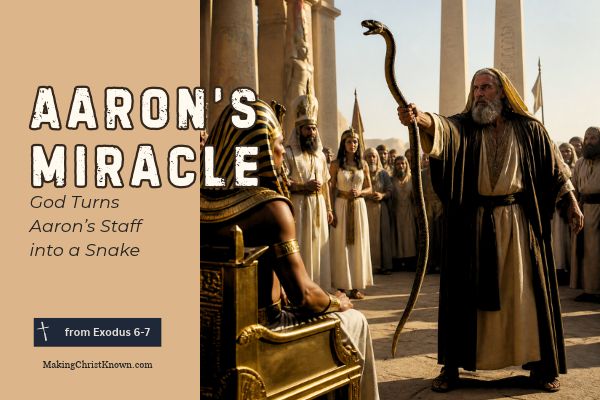
Now comes the dramatic moment. Moses and Aaron stand before Pharaoh, and Aaron performs the sign God commanded.
So Moses and Aaron came to Pharaoh, and thus they did just as the Lord had commanded; and Aaron threw his staff down before Pharaoh and his servants, and it became a serpent. – Exodus 7:10
Imagine watching a walking stick suddenly turn into a living snake! This was no ordinary event. God was showing Pharaoh that His power was greater than anything Egypt could offer.
However, Pharaoh wasn’t impressed for long. Instead of listening to God’s message, he called for his own wise men, sorcerers, and magicians.
They performed what appeared to be a similar sign through their secret arts.
Then Pharaoh also called for the wise men and the sorcerers, and they also, the magicians of Egypt, did the same with their secret arts. – Exodus 7:11
Each magician threw down his staff, and the staffs became serpents. But something remarkable happened next.
For each one threw down his staff and they turned into serpents. But Aaron’s staff swallowed up their staffs. – Exodus 7:12
This was a clear demonstration of God’s superiority. The Egyptian magicians could imitate the sign, but they could not overcome the power of God.
Sadly, Pharaoh still refused to listen.
Yet Pharaoh’s heart was hardened, and he did not listen to them, as the Lord had said. – Exodus 7:13
Why Did God Choose a Snake for Aaron’s Staff Miracle?
Why did God choose a snake for this particular miracle? Although Scripture doesn’t give us one specific explanation, there are some important details worth considering.
1. God Was Demonstrating His Authority
The staff was an ordinary object in Aaron’s hand. Yet God used it to perform something extraordinary. This showed Pharaoh that Moses and Aaron were not acting through their own strength. Their authority came from the Lord.
Furthermore, the serpent swallowing the other serpents demonstrated that God’s power was greater than the power claimed by Egypt’s magicians.
The message was simple: Pharaoh might rule Egypt, but he was not greater than God.
2. The Serpent May Have Had Special Meaning in Egypt
In ancient Egypt, the cobra was associated with royal authority and protection. The image of a serpent also appeared in Egyptian royal symbols.
Although the Bible doesn’t directly explain this connection, the sign would have carried powerful meaning in Pharaoh’s court.
God was showing that Egypt’s symbols of authority could not stand against Him. Even Pharaoh’s royal power was subject to the Lord.
3. The Miracle Prepared the Way for What Followed
The staff miracle was only the beginning. God was about to send a series of plagues that would reveal His power and expose the weakness of Egypt’s gods. Each event would bring Pharaoh closer to understanding that the Lord was in control.
We can read more about the meaning and purpose of miracles in our study of the significance of miracles in the Bible.
Relying on Miracles Instead of God
Taking God’s power before Pharaoh should have been enough to make him listen. Yet the miracle did not change his attitude.
God had given Moses authority, and Aaron had demonstrated that authority through the staff. Still, Pharaoh remained stubborn.
This brings up an important question: Should we rely on miracles to help us believe?
Wouldn’t it be wonderful if our spiritual lives were as simple as seeing a miracle or a sign? We might think that witnessing something extraordinary would remove every doubt.
However, that isn’t always how faith works.
Miracles can strengthen our faith and remind us of God’s power. Nevertheless, we should never make them the foundation of our relationship with Him.
Jesus made this point when He spoke to Thomas after His resurrection.
Jesus said to him, “Because you have seen Me, have you believed? Blessed are they who did not see, and yet believed.” – John 20:29
Jesus reminds us that genuine faith doesn’t depend on seeing something extraordinary. We can trust Him even when we don’t witness a miracle.
In fact, Hebrews gives us a wonderful description of faith.
Now faith is the assurance of things hoped for, the conviction of things not seen. – Hebrews 11:1
Faith means trusting God even when we can’t see the outcome. It means believing His promises when life doesn’t make sense.
Miracles and Spiritual Deception
There is another lesson in Pharaoh’s encounter with the Egyptian magicians. Not everything that looks supernatural comes from God. The Bible warns us that deception can sometimes appear convincing. Satan can use signs and wonders to draw people away from the truth.
Jesus even warned His followers about false prophets and misleading signs.
For false Christs and false prophets will arise and will show great signs and wonders, so as to mislead, if possible, even the elect. – Matthew 24:24
Therefore, we should never judge a spiritual experience by how amazing it looks. Instead, we must compare what we see and hear with God’s Word.
God will never contradict His own truth. Scripture gives us the foundation we need to recognize deception and remain faithful.
Again, Focus on God – Not Miracles
God certainly works miracles. We see them throughout the Bible, from the parting of the Red Sea to the healing ministry of Jesus. However, He works according to His will and purpose. We can’t demand a miracle or expect God to follow our timetable.
Pharaoh made a serious mistake. He focused on the strange event happening before him rather than listening to the message God had sent. As a result, his stubbornness brought even more suffering to Egypt and prolonged the Israelites’ bondage.
Think about how often we can make a similar mistake. We may spend so much time looking for signs that we overlook what God has already told us through Scripture.
Instead, we should seek Him first and trust His promises.
But seek first His kingdom and His righteousness, and all these things will be added to you. – Matthew 6:33
This doesn’t mean we should ignore the wonderful things God does in our lives. Rather, we should recognize His goodness without making miracles more important than the One who performs them.
We’ve Got Questions – The Bible Gives Answers
Life brings plenty of questions. Sometimes we face difficult situations and wonder what God wants us to do. When that happens, take time to read Scripture and pray. Ask God for wisdom, and be willing to follow the truth He has given us.
The Bible reminds us that God’s Word provides guidance for our lives.
Your word is a lamp to my feet and a light to my path. – Psalm 119:105
We don’t need to chase after every unusual experience or demand an outward sign before we trust God. Instead, let His Word guide your decisions. Remember, Pharaoh saw a miracle with his own eyes and still refused to believe.
The lesson from Aaron’s snake staff is clear: Seeing God’s power is not the same as trusting Him. True faith means listening to His Word, believing His promises, and following Him even when we can’t see what lies ahead.
Final Thoughts on Aaron’s Snake Staff
The story of Moses, Aaron, and Pharaoh reminds us that miracles alone can’t change a stubborn heart. God can show us His power in amazing ways, but we must still choose to listen and believe.
Don’t let the search for signs distract you from the message God has already given. Keep your eyes on Him, trust His Word, and allow your faith to grow through a personal relationship with Jesus Christ.
For more Bible studies and encouragement, visit Making Christ Known.
If you would like to discover more about receiving the love and life-changing experience of Jesus Christ, take a moment to read John 3:16.
Love in Christ,
Bob
*Verses from New American Standard Bible (NASB).
Discover more from Making Christ Known
Subscribe to get the latest posts sent to your email.