Have you ever been caught between a boss who demands the impossible and people who expect you to make it happen? Imagine being told to produce the same amount of work with fewer resources and no extra time. That is exactly what happened to the Hebrew people in Exodus 5. When Moses and Aaron asked Pharaoh to let Israel go, Pharaoh responded by making their lives even harder. The result was a painful lesson in leadership, faith, and what happens when we stand up for God.
Bible Study Lesson: Exodus 5:1-21
You probably remember this story from the Book of Exodus. Moses and Aaron approach Pharaoh with a message from God: Let His people go so they can worship Him in the wilderness.
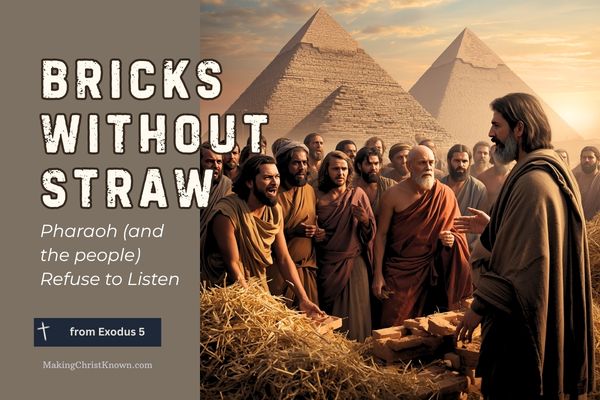
But Pharaoh refuses. In fact, he makes life much worse for the Israelites by ordering them to make bricks without straw.
Pharaoh did not recognize the Lord’s authority. He also had no desire to listen to Moses or respect the God of Israel.
As a result, the Hebrew workers, their foremen, and even Moses and Aaron found themselves caught in the middle of a terrible situation.
Have you ever felt that way? Perhaps you tried to do the right thing, only to find yourself facing criticism from both sides. This passage offers some helpful lessons for those difficult moments.
Pharaoh Refuses to Listen to Moses and Aaron
Moses and Aaron did exactly what God instructed. They went before Pharaoh and delivered His message. However, Pharaoh’s response showed just how little he understood God’s authority.
Then afterward Moses and Aaron came and said to Pharaoh, “Thus says the LORD, the God of Israel, ‘Let My people go that they may celebrate a feast to Me in the wilderness.’”
But Pharaoh said, “Who is the LORD that I should obey His voice to let Israel go? I do not know the LORD, and besides, I will not let Israel go.” Exodus 5:1-2
Notice Pharaoh’s question: “Who is the LORD?”
He was not simply asking for information. Pharaoh was rejecting the authority of the God who had sent Moses and Aaron.
The two men explained that the Hebrews needed to travel into the wilderness to sacrifice to the Lord. Yet Pharaoh saw their request as nothing more than an excuse to avoid work.
Instead of showing mercy, he decided to make their labor even harder.
Pharaoh Makes the Work Even Harder
Pharaoh believed the Israelites were becoming lazy. Therefore, he ordered the Egyptian taskmasters to stop supplying straw for brickmaking while keeping the same production quota.
“You are no longer to give the people straw to make brick as previously; let them go and gather straw for themselves.
But the quota of bricks which they were making previously, you shall impose on them; you are not to reduce any of it.” Exodus 5:7-8
Think about that for a moment. The workers had to find their own materials, yet they were still expected to produce the same number of bricks. Pharaoh was not interested in fairness. He wanted control.
How Did the Hebrews Make Bricks Without Straw?
To understand the hardship in Exodus 5, we need to look at how ancient brickmaking worked.
Egyptian workers commonly made mud bricks by mixing Nile mud with straw or other plant material. The straw helped bind the mud together and made the bricks stronger as they dried.
Without a regular supply of straw, the Hebrews had to search for whatever plant material they could find. They gathered stubble throughout Egypt while still trying to meet Pharaoh’s demanding production goals.
Imagine being forced to gather your own supplies, complete the same workload, and face punishment if you fell behind. That was the daily reality for these Hebrew workers.
Pharaoh’s order was more than a difficult work assignment. It was an attempt to crush their hope and discourage them from listening to Moses.
Increased Labor for Israel: The Poor Foremen
This part of the Exodus story sounds surprisingly familiar, doesn’t it?
The Egyptian taskmasters demanded results. The Hebrew foremen had to make sure the workers met their quotas. Yet the foremen had no control over the resources Pharaoh provided. They were responsible for results without having the authority or tools to achieve them.
Have you ever worked in a place where management expected more production but offered fewer resources? Perhaps you have watched a supervisor struggle to meet goals that seemed impossible from the beginning. That is the position these foremen faced.
They had to answer to Pharaoh’s representatives while also dealing with the suffering of their own people. Sadly, their complaints did not change the situation.
Caught in the Middle
Have you ever found yourself in a similar situation at work, at church, or even at home?
A worker who is well-liked by coworkers may suddenly become unpopular after accepting a supervisory position. The company owner wants things done a certain way, so the supervisor passes those instructions along to the crew.
However, the crew may feel the demands are unreasonable. When production falls behind, the supervisor gets called into the boss’s office.
It becomes a never-ending cycle.
This is how we can understand what happened to the Hebrew foremen. They were caught between Pharaoh’s unreasonable demands and the people who suffered under them.
But the story also reminds us that doing what is right does not always bring immediate relief.
What About Moses and Aaron?
There is no question that the Israelites had every right to complain. They were enslaved, forced to work, and given no freedom to leave.
Yet Moses and Aaron were also caught in the middle. God had sent them to deliver a message of freedom, but Pharaoh responded by increasing the suffering of the very people they wanted to help.
Can you imagine how discouraging that must have felt?
Moses had already faced his fears and obeyed God’s call. For a quick review, you can read more about Moses and the burning bush and how God prepared him for this mission.
Now, instead of seeing immediate progress, Moses watched the situation grow worse.
Still, Pharaoh’s refusal did not mean God had abandoned Israel. It meant the story of deliverance was not finished.
When Obedience Does Not Bring Immediate Results
Sometimes we expect that doing God’s will should make life easier. However, Scripture shows us that obedience can lead to difficult seasons before we see the results.
Moses and Aaron had followed God’s instructions, yet they faced resistance.
Likewise, we may experience frustration when we try to do what is right. We may even wonder whether we misunderstood God’s direction.
But a difficult response from others does not automatically mean we are on the wrong path. We must keep our eyes on God rather than judging His faithfulness by our immediate circumstances.
Christian Witness: When People Do Not Want to Listen
As Christians, we sometimes find ourselves in a similar position when sharing our faith.
We may talk with someone who does not believe in Christ. We share what God has done in our lives, but our words seem to fall on deaf ears.
In other situations, someone may become angry simply because we mention the name of Jesus.
That can be discouraging, especially when our intentions are good.
However, we should remember that we cannot force anyone to believe. Our responsibility is to share the truth with love, show patience, and live in a way that reflects Christ.
We can learn from other biblical examples of faithful people who stood firm when others opposed them. For instance, read Daniel: Leading with Faith in a Hostile Culture.
Daniel’s example reminds us that faithfulness matters even when the surrounding culture does not welcome our beliefs.
We Can’t Save Anyone!
One of the most important lessons we can take from Exodus 5 is that we are not responsible for controlling the outcome of every situation.
We cannot change Pharaoh’s heart. Moses and Aaron could deliver God’s message, but they could not force Pharaoh to obey.
In the same way, we cannot save another person’s soul through our own efforts.
Our calling is to tell others what God has done for us, share the message of Jesus Christ, and live a life that encourages others to seek Him.
We should speak with kindness, show compassion, and let our actions support our words.
Saving souls is God’s job. Sharing His love is our privilege.
So, when you feel caught in the middle, remember Moses and Aaron. Their difficult circumstances did not cancel God’s plan. Pharaoh’s resistance could not stop the Lord from fulfilling His promises to Israel.
We may not always understand what God is doing in the moment. Nevertheless, we can trust Him to remain faithful, even when the road ahead looks impossible.
Love in Christ,
– Bob
For more Bible studies, practical lessons, and encouragement for everyday Christian living, visit Making Christ Known. If you would like to discover the love and life-changing experience of Jesus Christ, please take a moment to read John 3:16 for more information.
*Verses from New American Standard Bible (NASB).
Discover more from Making Christ Known
Subscribe to get the latest posts sent to your email.